
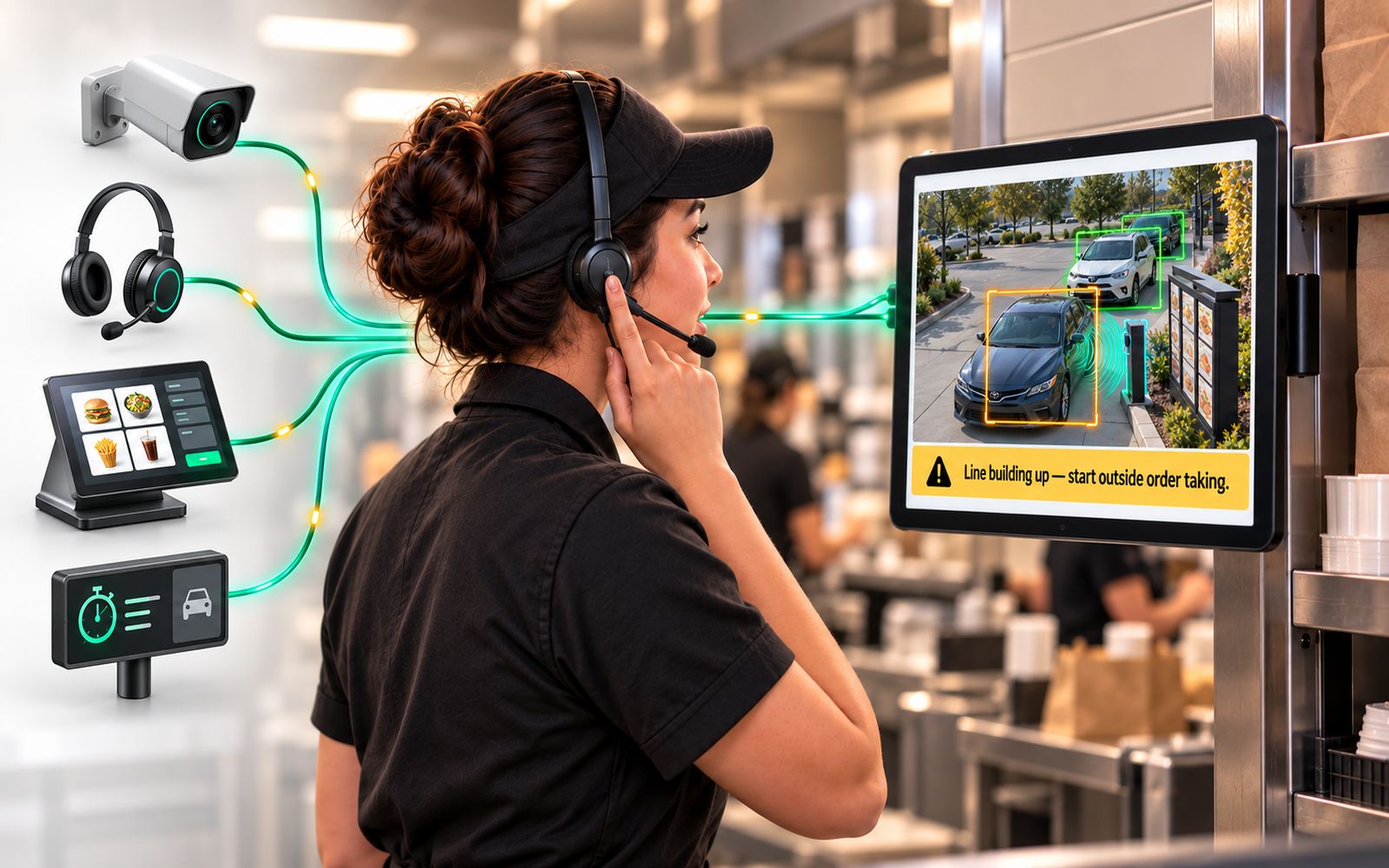
At FS/TEC, one trend was impossible to miss: restaurant technology is becoming increasingly connected. Point-of-sale providers are expanding into broader platforms, front-of-house and back-of-house systems are sharing more data, and capabilities that once had to be purchased independently are increasingly being brought together.
That is an important step forward for QSR operators. But it also raises a bigger question:
Once everything is connected, how does all that technology actually improve what happens inside the restaurant?
AI Is Everywhere. Adoption Will Take Time.
AI was everywhere at FS/TEC, from kitchen operations and supply chain to vision systems, analytics and drive-thru voice ordering. Operators, however, are at very different stages of adoption. Some are actively deploying AI, others are testing it, and many are still determining where it can create measurable value.
That shouldn’t be surprising. AI ordering asks guests to change their behavior, much like the shift from brick-and-mortar retail to online shopping. Today, ordering almost anything online feels completely normal, but that shift didn’t happen overnight. Even companies such as Amazon spent years refining the customer experience, improving the technology and building consumer trust. Restaurant AI will likely follow a similar path.
Some customers will always prefer interacting with a person. But many others care less about whether the interaction is human or AI and more about whether the experience is fast, accurate, easy and courteous. Adoption will also vary by market, demographic, restaurant concept and use case. Some customers and brands will move quickly; others will be later adopters.
The question isn’t whether every guest wants AI, or whether every guest wants a person. What matters is whether the technology consistently delivers the experience the guest expects.
Connected Doesn’t Automatically Mean Better
The same is true of connected systems. POS, drive-thru timers, loyalty platforms, labor systems, vision AI, conversation AI and guest feedback can collectively provide a much richer understanding of what is happening inside a restaurant. But connecting those systems isn’t the finish line. The real value comes from turning that information into action.
Consider a simple example that came up at FS/TEC: when vehicles are pulled forward in the drive-thru, operators can lose visibility into how long those guests are actually waiting. Restoring that visibility matters. In fact, simply measuring something can improve performance because teams become more aware of it.
But visibility alone has limits. A dashboard showing a manager twelve things going wrong doesn’t tell them what deserves attention first. An alert about a poor interaction that arrives after the guest leaves may document the problem, but it doesn’t help the employee improve the interaction while it is happening. And technology that feels primarily punitive quickly becomes something employees and managers learn to ignore.
From Visibility to Action
The next evolution of restaurant technology isn’t simply collecting more data. It’s answering four questions:
- What happened?
- Why did it happen?
- What should we do about it?
- Can we act while the outcome can still be changed?
That last question is the most important. Connected restaurant systems should help managers and frontline employees make better decisions in real time, not simply create another report for someone to review later. For the people running the restaurant, we believe that comes down to two things:
- Clear priorities for managers. Connected data should narrow a manager’s attention rather than expand it. Instead of presenting dozens of metrics, technology should identify the one or two issues that deserve attention right now, and provide enough context to understand why.
- In-the-moment coaching for employees. The most valuable insight arrives while the employee can still act on it. Rather than simply scoring performance after the fact, technology should provide timely guidance that helps the employee improve the current interaction, or the very next one.
Technology Should Support the Experience, Not Define It
The future restaurant experience won’t be entirely human or entirely automated. It will be a combination. That’s why the most effective technology is often the kind guests barely notice.
AI can observe interactions, identify patterns, recognize emerging issues and help employees and managers respond more effectively. The human team can then focus on what people do best: judgment, hospitality, empathy and handling situations that don’t fit neatly into an algorithm.
And restaurants provide plenty of those situations. Real operations are messy. Cars get pulled forward, bags move between stations, employees change positions, and rushes don’t follow demo scripts. Technology has to work in that environment, not just in a controlled demonstration.
Start With the Problem, Not the Technology
With so much innovation entering the QSR industry, it can be tempting to start with the newest technology and then search for a reason to deploy it. We believe operators should approach it from the opposite direction. Start with a simple question: what is the biggest operational or guest-experience problem we’re trying to solve? Then determine what data is needed to understand it, what systems need to be connected and, most importantly, what action should happen as a result.
At uKnomi, creating exceptional guest experiences has been at the heart of our vision and mission from the start, and it’s what we strive to help our customers deliver every day. Connected data is how we get there: turning drive-thru interactions into clear priorities for managers and real-time coaching for crews.
Because ultimately, the goal isn’t more dashboards, more alerts or even more AI. The goal is better execution. Connected data becomes valuable when it helps the right person take the right action while there is still time to change the outcome, and turn an ordinary visit into an exceptional guest experience.
If you’re thinking about what comes after connected systems, we’d love to compare notes.